zero trust architecture enterprise
Zero Trust Architecture for Enterprise: Implementation Guide for Engineering and Security Teams
A practical guide to zero trust architecture implementation for enterprise engineering teams: identity-centric access controls, network segmentation, device trust, and workload-to-workload authentication.
TL;DR — Key Points
- 1Zero trust is an identity programme first, a network project second — start with strong IdP and MFA before network segmentation
- 2Device posture checks in access policies: unmanaged or unhealthy devices get restricted access, not full user access
- 3Microsegmentation starts with crown-jewel systems — production databases and identity infrastructure — not the full network
- 4SPIFFE/SPIRE or service mesh mTLS for workload identity eliminates the static credential problem most programmes ignore
Zero Trust Architecture for Enterprise: Implementation Guide for Engineering and Security Teams
Zero trust has become one of the most overloaded terms in enterprise security. Every major security vendor has a "zero trust" product. NIST has a framework. Your cyber insurer has started asking about it. But the implementations vary wildly — from meaningful architectural changes that reduce lateral movement risk to little more than VPN replacement with better marketing.
The core principle is straightforward: never trust any network connection or identity claim implicitly, regardless of source location. Verify every access request against identity, device health, and context before granting access. This sounds simple but implementing it across a hybrid enterprise environment with legacy systems, third-party SaaS, and cloud workloads is a multi-year programme.
This guide covers the four pillars of a zero trust implementation and the sequencing decisions that determine whether the programme delivers security improvement or just security theatre.
Why zero trust programmes deliver less than promised
Zero trust implementations fail to deliver expected security improvements for three consistent reasons. First, network-only implementations: organisations replace their VPN with an identity-aware proxy and call it zero trust. But if the internal network still allows implicit lateral movement between systems — any authenticated system can reach any other system on port 443 — the actual attack surface has not changed materially. Zero trust requires east-west network controls, not just north-south access control at the perimeter.
Second, device trust is ignored: zero trust access decisions that verify identity but not device health allow a compromised managed device (or an unmanaged personal device) to authenticate as a legitimate user. Device posture checks — Is this device enrolled in MDM? Is the OS patched? Is disk encryption enabled? — must be part of the access policy, not optional extras.
Third, workload-to-workload authentication remains implicit: human user access gets zero trust treatment, but service-to-service communication inside the infrastructure uses static long-lived credentials or implicit network-based trust. SPIFFE/SPIRE or service mesh mTLS for workload identity is the frequently missing piece in otherwise mature zero trust programmes.
Four Pillars of Enterprise Zero Trust Implementation
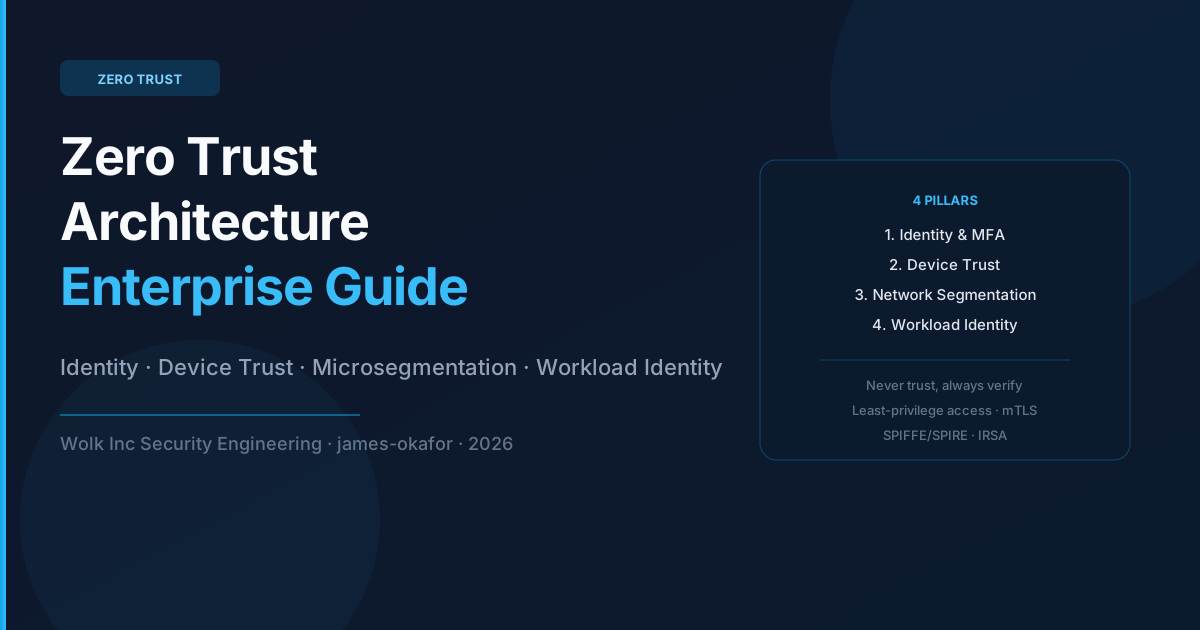
These four pillars address the most impactful attack surfaces in enterprise environments. They should be implemented in sequence — identity first, then device trust, then network segmentation, then workload identity.
Pillar 1: Identity as the new perimeter
Zero trust starts with strong identity. This means: all user authentication through a centralised IdP (Okta, Azure AD, Google Workspace) with MFA enforced for all users with no exceptions, adaptive authentication that increases friction for anomalous login patterns (unusual location, new device, off-hours access), and just-in-time privileged access management (CyberArk, BeyondTrust, or AWS IAM Identity Center session management) that eliminates standing privileged access. Federated identity for third-party SaaS and partner access. Service account inventory and rotation — most enterprise environments have hundreds of stale service accounts with excessive permissions that were never reviewed. Identity is the highest-leverage starting point because it applies to the widest range of access vectors.
Pillar 2: Device trust and health enforcement
Access policies should incorporate device health signals: MDM enrolment status, OS patch level, disk encryption state, and presence of endpoint protection software. Google BeyondCorp Enterprise, Zscaler Private Access, and Cloudflare Access all support device posture checks as part of their access policies. For Microsoft-heavy environments, Intune compliance policies integrated with Azure AD Conditional Access provide the device trust layer. The principle is: a user who authenticates correctly from an unmanaged or compromised device should receive restricted access or no access to sensitive resources, not the same access as a user on a healthy managed device.
Pillar 3: Network microsegmentation for east-west control
Traditional network architecture grants implicit trust to everything inside the corporate network or VPC. Zero trust requires microsegmentation: defining explicit allow rules between workloads and blocking all other traffic by default. In AWS, this means VPC security groups and network ACLs designed around least-privilege communication paths, not security groups that allow broad intra-VPC traffic. In Kubernetes, NetworkPolicy resources restrict pod-to-pod communication to declared paths. For legacy on-premises environments, host-based firewall enforcement (using a policy management tool like Illumio or Guardicore) can provide microsegmentation without full network redesign. Start with crown-jewel systems — production databases, payment processing services, identity systems — and expand segmentation outward.
Pillar 4: Workload identity and service authentication
Service-to-service authentication using static credentials (long-lived API keys, hardcoded passwords, shared secrets) is the missing zero trust pillar in most enterprise implementations. SPIFFE (Secure Production Identity Framework For Everyone) and its reference implementation SPIRE provide short-lived cryptographic workload identity certificates that rotate automatically and require no static secrets. In Kubernetes environments, a service mesh (Istio, Linkerd) with mTLS enabled provides workload-to-workload authentication and encrypts east-west traffic as a side effect. AWS IAM roles for workloads (via IRSA for EKS, EC2 instance profiles) eliminate the need for static AWS credentials in workload code. Eliminating static service credentials from infrastructure is one of the highest-impact zero trust implementations for cloud environments.
Identity-centric access controls, device health enforcement, network microsegmentation, and workload identity — implemented in this sequence, these four pillars deliver meaningful zero trust security improvements rather than compliance theatre.
Zero trust implementation for a financial services platform
A financial services technology firm engaged Wolk Inc to design and implement a zero trust architecture programme following a cyber insurance renewal that required demonstrating zero trust progress within 12 months.
Wolk Inc assessed the existing security posture and identified the highest-risk gaps: no MFA on 30% of internal SaaS tools, standing admin access to production databases, VPC security groups allowing broad intra-VPC traffic, and 400+ stale service accounts with no rotation policy.
The 12-month programme delivered: Okta MFA enforced across all 47 SaaS applications, CyberArk just-in-time access for production database administration, VPC microsegmentation with security groups scoped to workload communication pairs, IRSA-based workload identity for all EKS services eliminating static AWS credentials, and service account inventory reduced to 180 active accounts with 90-day rotation. The cyber insurance renewal passed with no premium increase, and a subsequent penetration test confirmed the lateral movement attack paths identified in the original assessment were no longer viable.
Actionable takeaways
- Zero trust is an identity programme first, a network project second — start with strong IdP and MFA before network segmentation
- Device posture checks in access policies: unmanaged or unhealthy devices get restricted access, not full user access
- Microsegmentation starts with crown-jewel systems — production databases and identity infrastructure — not the full network
- SPIFFE/SPIRE or service mesh mTLS for workload identity eliminates the static credential problem most programmes ignore
- Implement in sequence: identity, device trust, network segmentation, workload identity — parallel implementation creates governance gaps
Wolk Inc Engineering Team
Senior Engineers · Since 2021
This article was written by Wolk Inc senior engineers with hands-on experience delivering zero trust architecture enterprise programs for startups and SMBs across the US, Canada, Australia, New Zealand, and Europe.
Planning a zero trust architecture programme?
Wolk Inc designs and implements zero trust architecture programmes for enterprise technology organisations: identity hardening, device trust policy, network microsegmentation, and workload identity. Book a 30-minute call to discuss your current posture, the highest-risk gaps, and a sequenced implementation plan.
Wolk Inc is a 2021-founded senior-only tech services firm helping startups and SMBs in the US, Canada, Australia, New Zealand, and Europe — specialising in web development, social media marketing, web scraping, DevOps, cloud, AI, and cybersecurity. No junior staff, no middlemen.